
Sub-Total: R0.00
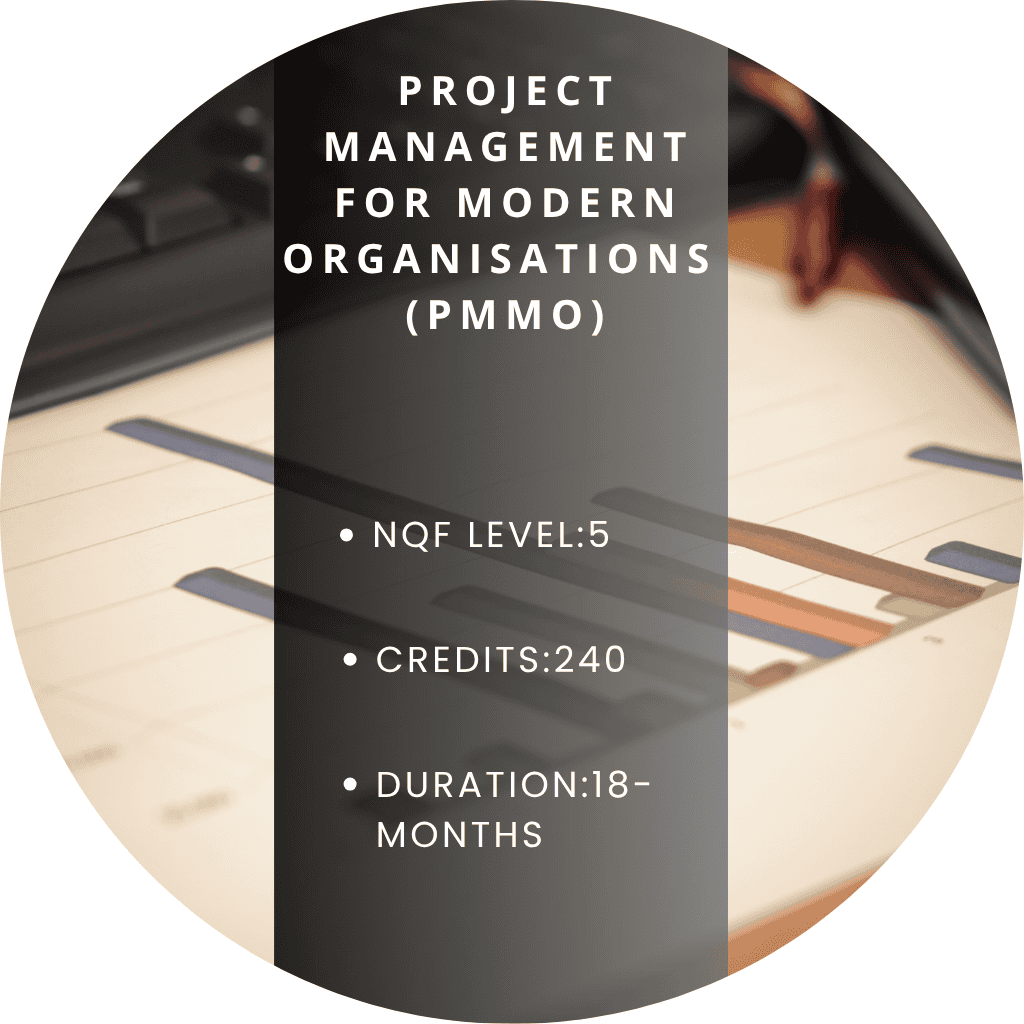
Project Management for Modern organisations (PMMO)
Price range: R35,000.00 through R65,000.00 EX VAT
Knowledge Management Series – Non‑Accredited Short Course
Equivalent NQF Level: 5 | Credits (Equivalent): 4 | Duration: 2 Days
Gain foundational project management skills tailored for learning and development environments. This course covers project initiation, planning, scheduling, execution, monitoring, reporting, and closure—equipping practitioners to manage L&D projects effectively and in alignment with organisational and statutory requirements.
Description
Purpose and Rationale
This short course equips Training and Development Practitioners with foundational project management knowledge and skills needed to initiate, plan, execute, monitor, and close learning and development (L&D) projects. Learners will gain an understanding of core project management principles and processes and learn how to apply them within organisational learning contexts.
By the end of this course, participants will be able to use essential project management tools and documentation to support the successful delivery of L&D initiatives — ensuring projects are delivered within scope, on time, on budget, and in alignment with statutory and organisational requirements.
Ideal for aspiring project managers, L&D practitioners, training coordinators, and professionals responsible for organising and overseeing learning interventions.
Course Content
This course covers:
- Project management process groups: Initiating, Planning, Executing, Monitoring & Controlling, Closing
- Core project areas: scope, time, cost, quality, risk, resources, communication, stakeholders, light procurement (venues, facilitators, tech)
- Key PM tools: project charter, WBS, Gantt chart/schedule, RACI matrix, risk register, issue/change logs, budget sheet, status reports, lessons learned templates
- Application in L&D contexts: training rollouts, learnerships, WBL projects, curriculum updates, compliance/reporting cycles (WSP/ATR), LMS implementations
- Governance: organisational policies, QA requirements, Skills Development Act, SETA/QCTO frameworks
Learning Outcomes & Assessment Focus
Outcome 1: Explain foundational project management concepts and their relevance to L&D
Learners will:
- Differentiate between projects and operations
- Define scope, constraints, stakeholders, and success criteria
- Explain how PM supports learning delivery, compliance, and quality assurance
- Identify the L&D practitioner’s role in project teams
Outcome 2: Initiate an L&D project and develop a basic project charter
Learners will:
- Draft a project purpose, objectives, high‑level scope, and success measures
- Identify stakeholders and governance structures
- Ensure alignment with SETA timelines and compliance requirements
Outcome 3: Plan the project using essential PM tools
Learners will:
- Create a WBS and schedule
- Develop a RACI matrix and resource plan
- Prepare a basic budget and identify risks
- Establish communication structures and templates
Outcome 4: Execute, monitor, and control the L&D project
Learners will:
- Coordinate resources, logistics, and stakeholder communication
- Track progress using KPIs (readiness, attendance, completion, quality)
- Maintain issue, risk, and change logs — implementing corrective actions
- Produce clear status reports
Outcome 5: Close the project and capture lessons learned
Learners will:
- Review project performance against scope, time, cost, quality, and satisfaction
- Compile a closure report with evidence and outcomes
- Document lessons learned for future improvement
Who Should Enrol?
- Project team members in L&D
- Training coordinators and administrators
- Skills Development Practitioners
- Emerging project managers
- HR and L&D professionals involved in rollouts or implementation
Learning Assumed to Be in Place
Learners should have:
- Communication skills at approximately NQF Level 4
- Basic understanding of workplace learning, facilitation, or assessment
- Familiarity with organisational processes and compliance frameworks
Recognition of Prior Learning (RPL)
RPL may be granted for learners who provide evidence such as:
- Previous project plans, schedules, budgets, reports
- Stakeholder engagement records
- Evidence of involvement in project coordination
- Portfolio items demonstrating PM competence
Assessment Methods
- Formative: concept quizzes, draft charters, WBS, schedules, risk registers, mock status reports, reflective journals
- Summative: full Project Management Portfolio including plans, schedules, budgets, evidence, status reports, and closure documentation
- Integrated Assessment: workplace/WIL validation and cross‑mapping to outcomes
Additional information
| Delivery Method | LMS / Self-Paced, Virtual Facilitated, In-Person Premium |
|---|
Related products
-
Leading With Strategy and Management Perspective
Price range: R18,000.00 through R45,000.00 EX VAT Select options This product has multiple variants. The options may be chosen on the product page -
New Venture Creation / Entrepreneur SMME
Price range: R18,000.00 through R45,000.00 EX VAT Select options This product has multiple variants. The options may be chosen on the product page -
Entrepreneur Support & Business Consulting Programme
Price range: R35,000.00 through R65,000.00 EX VAT Select options This product has multiple variants. The options may be chosen on the product page -
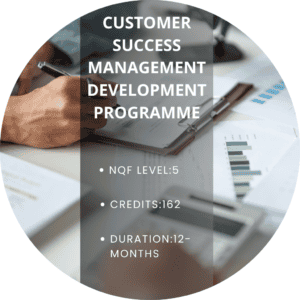
Customer Success Management Development Programme
Price range: R18,000.00 through R45,000.00 EX VAT Select options This product has multiple variants. The options may be chosen on the product page